
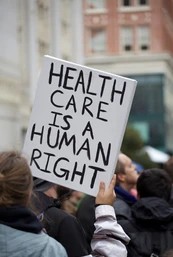
When I think about health, the thought of it being a Human Right pops into my mind. Unfortunately, like all Human Rights, without sufficient resources, health remains merely a promise. Health financing isn’t just about money, it’s about whether a doctor back in the village has the basics to do their job. It’s about whether a mother can safely give birth and whether this baby gets the chance to survive their first year.
We annually celebrate World Health Day on the 7th of April, and this year’s theme was ‘Healthy Beginnings, Hopeful Futures’, a campaign focused on maternal health, urging governments to ramp up efforts to end preventable maternal and newborn deaths. I can’t help but wonder, though, why does health still compete for scraps in national budgets when it is the foundation of everything else in society, including dignity, hope, productivity, and education? How can we ensure healthy beginnings or any kind of future without confronting our heavily underfunded public health systems?
In this post, I will unpack why health financing matters and how it can shape the future of Kenya.
Where the Money Goes, Health Grows

I’d like to introduce you to the term health equity. This means that everyone is given a fair and just opportunity to be healthy and stay healthy. But this ideal isn’t possible without strategic investment in public health systems. Public health funding is the foundation for a healthier and fairer society, as it allows funding to be available at the right places, improving access to care. This is the core function of health financing as it supports the progression towards universal health coverage.
In 2011, a study conducted across the United States concluded that increasing public health government funding by even 10% could prevent up to 6.9% of total deaths. Even at low levels of spending, worthwhile health interventions have the potential to improve lives and reduce preventable mortality. Health financing promotes access to clean water, proper nutrition, maternal care, mental health support, and health education.
Missing Pieces in the Puzzle of Care

This year’s theme highlights the urgent gap in maternal and child health. In Kenya, maternal mortality stands at 362 deaths per 100,000 live births, while neonatal mortality stands at 21 per 1,000; alarmingly high rates. These outcomes reflect a lack of access to quality healthcare, skilled professionals, medical supplies, and well-equipped facilities. Financial strain also prevents many women from seeking care. Linda Mama intended to decrease such barriers; however, the initiative has become inaccessible in the new SHA scheme due to financial burdens on parents of teen mothers, complicated dependent registration, and overall confusion surrounding the transition.
Kenya also struggles with uneven distribution of resources, with many rural areas receiving the short end of the stick. During my time working in northern Kenya last year, I encountered areas that lacked access to health facilities, decent roads, and clinic staff. In some situations, facilities were completely abandoned due to a shortage of personnel. True equity is impossible to achieve without adequate health-care infrastructure.
Lastly our national budget allocations raise a lot of additional concern. Kenya has continuously fell short of the 2001 Abuja Declaration of 15 % government health expenditure. For the year 2023/24, Kenya’s health expenditure was at 11%, which is below the threshold.
Recently, the US government withdrew USAID and PEPFAR, which have been core donors for key health programs in Kenya. The US government was heavily funding programs on malaria, TB, HIV, immunization, and reproductive health. In 2022, the US provided for 57% of the total HIV expenditure, while the Kenyan government contributed only 8% of funding at the time. With declining donor financing, national and county governments are primarily responsible for health-care services, yet our potential to achieve health independence remains uncertain as long as we neglect funding our domestic healthcare systems.
These examples are just a fraction of the growing gaps in public health due to a lack of proper health financing.
It’s Not Charity, It’s a Right
As a country, we need to urgently realize how public health funding is essential. I see this as an opportunity for the government to step up and reallocate resources to health in our national and county budgets. I am a big follower of data-driven decision-making, and for sure, the numbers don’t lie. There should be a priority on essential health programs and a reduction of donor dependence to provide these services.
There is also a need to manage our health resources. It is not enough to build a facility if it stands empty; no medicine, no staff, no equipment; it is a structure, not a solution. Health funding should be directed to interventions that work for the community. A reallocation of finances should prioritize strengthening primary healthcare facilities, ensuring a reliable supply of essential medicines and equipment, and incentivizing healthcare workers to serve in underserved areas.
Strengthening of health infrastructure should also be prioritized. And not only supporting our healthcare workers and having well-equipped health facilities, but also ensuring our counties have roads, electricity, and accessible water.
“Healthy beginnings require intentional and sustained investment because hope doesn’t grow in neglect.”
A Future Worth Fighting For

When I imagine healthy beginnings, I think of the lives lost to preventable causes and everyone who was not given the chance to live a healthy life. We should progress towards protecting dignity, safety, and equity in health. If we want a future where more people can thrive, we must invest in the start of life. The truth of the matter is that when we underfund public health, we don’t just lose money, we lose lives, potential, and generations of possibilities.
Well, that’s it for today’s heart-to-heart (and other body parts) conversation. I hope this will spark your interest in the importance of public health financing. As always, share your thoughts in the comments, like the post, and share.
Until next time…….
By Joan Bulinji Machanje
REFRENCES
National Syndemic Diseases Control Council (NSDCC), National AIDS and STI Control Programme (NASCOP), University of Manitoba, Futures Health Economics and Metrics & Bill & Melinda Gates Foundation, 2023. Costing HIV prevention in Kenya: Towards achieving an equitable and efficient response to the HIV epidemic. Contributors: Mwai, D., Rotich, W., Kaberia, J., Langat, A., Lukoba, B., Mugambi, C., Arimi, P., Blanchard, J., Bhattacharjee, P. & Masha, R.L. Summary by Pillai, P. [pdf] Available at: https://nsdcc.go.ke/wp-content/uploads/2023/08/HIV-Prevention-Costing-Summary_FINAL-6th-July-2023.pdf
National Syndemic Diseases Control Council (NSDCC), 2025. Kenya moves to secure HIV response amid shifting donor funding, prioritizing sustainable local solutions. Available at: https://nsdcc.go.ke/kenya-moves-to-secure-hiv-response-amid-shifting-donor-funding-prioritizing-sustainable-local-solutions
Mays, G.P. and Smith, S.A., 2011. Evidence links increases in public health spending to declines in preventable deaths. Health Affairs (Millwood), 30(8), pp.1585–1593. doi:10.1377/hlthaff.2011.0196.
World Health Organization (WHO), 2025. World Health Day 2025. Available at: https://www.who.int/campaigns/world-health-day/2025
Walden University, 2024. 10 Facts About Public Health Funding. Available at: https://www.waldenu.edu/programs/health/resource/ten-facts-about-public-health-funding
World Health Organization (WHO), 2025. Health equity. Available at: https://www.who.int/health-topics/health-equity#tab=tab_1
Cylus, J., Sallaku, J. and Jowett, M., 2022. Financing. In: I. Papanicolas, D. Rajan, M. Karanikolos, et al., eds. Health system performance assessment: A framework for policy analysis [online]. Copenhagen: European Observatory on Health Systems and Policies. (Health Policy Series, No. 57.) Chapter 6. Available at: https://www.ncbi.nlm.nih.gov/books/NBK590186/
Gitobu, C.M., Gichangi, P.B. and Mwanda, W.O., 2018. The effect of Kenya’s free maternal health care policy on the utilization of health facility delivery services and maternal and neonatal mortality in public health facilities. BMC Pregnancy and Childbirth, 18, p.77. Available at: https://doi.org/10.1186/s12884-018-1708-2


 Heart to Heart... and other body parts
Leave a comment